Pain guide · Back pain

Upper back pain when lifting your arm: the shoulder blade, the rotator cuff, the neck and what helps

Upper back or shoulder blade pain when you lift or raise your arm usually comes from the muscles that move the shoulder blade, the rotator cuff in the shoulder, a stiff joint in the upper spine or ribs, or a trapped nerve in the neck, which can cause shoulder blade pain weeks before any pain in the arm. Lifting the arm turns the shoulder blade on the ribs and moves the neck and upper back too (our reading of the anatomy), so where it hurts and what comes with it are the best clues. No study counts how often each is the cause. It is rarely serious, and it is rarely just a knot.

This guide starts with the signs that need help now: a 999 call or accident and emergency (A&E) for chest pain or pressure, breathlessness, sweating or feeling sick, a sudden tearing pain or a weak arm with a drooping face; the National Health Service's 111 line (NHS 111) for discomfort that comes on with effort and eases with rest, which can be angina; and a same-day check through NHS 111 or a general practitioner (GP) for sudden weakness lifting the arm after a fall. It then maps the causes by where it hurts, explains why a scan rarely helps at first, shows how to reach, lift, carry and sleep for now, and gives a three-stage plan with a 3D demo of every move, from supported arm lifts to overhead work and sport.

When to get help first

Exercise is for pain that has been checked or is clearly mild and settling.

Get urgent medical help if

  • Call 999 or go to A&E: back pain with chest pain, or back pain that started after a serious accident, such as a car crash.
  • Call 999: sudden pain or discomfort in your chest that does not go away (it can feel like squeezing or pressure, burning or indigestion); pain that spreads to your left or right arm, or your neck, jaw, shoulder, stomach or back; or chest pain and you feel sweaty, sick, light-headed or short of breath. It could be a heart attack. Don't drive yourself to A&E.
  • Get help from NHS 111: pain or tightness in your chest, neck, shoulders, jaw or arms that comes and goes, often brought on by exercise, stress, emotion or cold and easing after a few minutes' rest. It can be angina, a sign of a heart problem. If you've been diagnosed with angina, get help from NHS 111 too if it feels worse than before, is happening more often, lasts longer or happens when you're resting.
  • Call 999 or go to A&E if breathing suddenly becomes difficult, if pain in your chest or upper back comes on suddenly with breathlessness or a very fast heartbeat, or if someone passes out. Do not drive yourself. It can be a blood clot that has reached the lungs.
  • Call 999: sudden chest or back pain that can feel like something being torn inside, and causes shortness of breath, and problems with walking, vision and speaking (the NHS's wording, on its costochondritis page). It can be a tear in the wall of the body's main artery (an aortic dissection). Don't drive yourself to A&E.
  • Call 999: you suddenly can't fully lift both arms and keep them there, because of weakness or numbness in one arm, especially if one side of your face droops or you slur your words or sound confused. It could be a stroke. Call even if the signs have stopped.
  • Call 999 or go to A&E: after a fall or injury, your shoulder looks out of place or has changed shape, you cannot move your arm, or your shoulder is painful, bruised or swollen. Do not drive yourself, and do not try to put it back in yourself.
  • Same day (GP or NHS 111): sudden or very bad shoulder pain; you cannot move your arm; the arm or shoulder is badly swollen or has changed shape; pins and needles that do not go away; no feeling in the arm; the arm is hot or cold to the touch; pain that started after an injury such as a fall; or severe pain in both shoulders.
  • Same day (GP or NHS 111): sudden weakness lifting the arm after an injury or fall. A rotator cuff tear caused by an injury needs urgent referral to a shoulder specialist. After a dislocation in anyone over 40, the rotator cuff should be checked: about 40% have a tear.
  • Same day (GP or NHS 111): the shoulder or arm is hot, swollen or red, or you have a high temperature (although not everyone has one) or feel unwell. A joint infection needs same-day care.
  • Same day (urgent GP appointment or NHS 111): severe neck pain that starts suddenly or gets worse quickly; heaviness or weakness in the arms or legs; pins and needles in an arm along with neck or arm pain; or pain between the shoulder blades.
  • Call 999 or go to A&E: new problems walking, loss of bladder or bowel control, or a sudden loss of coordination, such as difficulty doing up buttons. These can be signs of pressure on the spinal cord.
  • Same day (urgent GP appointment or NHS 111): pain in your tummy, often in the middle or just under the ribs on the right, that lasts longer than 30 minutes; it may spread from there to your side or shoulder blade. It can be gallstones.
  • Call 999 or go to A&E: you have sudden, severe pain in your tummy; pain that spreads from your tummy to your back, and you're being sick; your temperature is very high, or you feel hot, cold or shivery; or your skin or the white part of your eyes looks yellow. These can be signs of a problem with gallstones.
  • Same day: you have or have had cancer, and new back pain that is severe and doesn't let up, is getting steadily worse, is worse at night and disturbs your sleep, is worse when you cough, sneeze or strain, or comes with tenderness over the spine. Contact your cancer team or GP urgently. With cancer, new weakness, difficulty walking, numbness or bladder or bowel problems are an emergency.

See a doctor or physiotherapist if

  • Pain at the top of the back, between the shoulders, rather than in the lower back.
  • Pins and needles or a cold arm alongside neck pain, or a new loss of strength or feeling in the arm that you cannot explain (a possible nerve problem).
  • You can't lift your arm above shoulder height yourself, though someone else can lift it for you, and it hasn't improved within 6 weeks of exercise and advice: see a GP or physiotherapist. Weakness that is getting worse needs checking sooner (our suggestion).
  • Pain that is getting worse or has not improved after 2 weeks of looking after it yourself, or it is very hard to move your arm. In many areas you can refer yourself to physiotherapy.
  • A shoulder blade that suddenly sticks out, or new weakness lifting, pushing or carrying: see a GP. Nerve tests may be needed to find which nerve is affected and how badly.
  • Severe shoulder or neck pain, often at night and needing strong painkillers, followed days or weeks later by weakness or winging: see a GP promptly and mention neuralgic amyotrophy, as early treatment may help. Breathlessness that gets worse when you lie down is a reason to see a GP too.
  • Sudden new back pain after a minor fall, lift, cough or sneeze, from 50 or past the menopause, or if you take long-term steroid tablets; or height loss, a curved spine or a change in posture: see a GP. It can be a spinal fracture.
  • You smoke or used to, and have shoulder pain with a cough that will not go away, breathlessness or weight loss. See a GP if you've had a cough for longer than 3 weeks; if you've coughed up blood, ask for an urgent GP appointment or get help from NHS 111.
  • See a GP if you have pain and stiffness for more than a week, especially if you're over 50, it's in both shoulders (often the neck and hips too) and the stiffness lasts longer than 45 minutes in the morning. It can be polymyalgia rheumatica.
  • A burning, tingling or painful patch of skin on one side of your back or chest, with or without a rash: get advice from a pharmacist or NHS 111 as soon as possible. Shingles can cause pain a few days before the rash appears, and rarely without one. Try to see a pharmacist within 3 days of the rash appearing.
  • A past history of cancer, an unexplained lump or swelling, weight loss, or pain that is constant and does not ease when you change position.
  • An ache over the back of the shoulder blade with weakness lifting your arm or turning it outwards, or the muscle over the blade looking thinner: see a GP or physiotherapist. The nerve to those muscles can be squeezed, and it does better when it's found early (our suggestion).
  • Upper back stiffness that is worse in the morning and at night and eases with exercise, with pain where the ribs join the spine or breastbone, or a deep breath that is hard to take, especially if it started before 45: see a GP. It can be ankylosing spondylitis.

Where does it hurt?

Location narrows the likely causes; it does not diagnose.

Along the inner edge or top corner of the shoulder blade, a dull ache or burning that builds while the arm is held up or reaching and eases when you lower it, tender to press

Usually the muscles that move and hold the shoulder blade (the trapezius, rhomboids and levator scapulae). This guide's plan is built for it.

The shoulder and upper arm, sometimes the back of the shoulder and blade, worse partway up as you lift the arm out to the side (a painful arc), reaching behind and lying on it

The rotator cuff (subacromial pain). Our shoulder pain when lifting your arm guide covers it.

Read: Shoulder pain lifting your arm →
Already told it's shoulder impingement or rotator cuff tendinopathy

Our shoulder impingement guide has the plan.

Read: Shoulder impingement (rotator cuff pain) →
Weakness lifting or turning the arm out, after a fall or a jerking lift, or over 40

A possible rotator cuff tear: get help the same day if it came on suddenly.

Read: Rotator cuff tear →
From the neck over or between the shoulder blades, with pain, pins and needles or numbness down the arm; sometimes easier with your hand resting on your head

A trapped nerve in the neck (cervical radiculopathy). The shoulder blade pain can start weeks before the arm pain.

Read: Pinched nerve in the neck →
Beside the spine between the blades or over a rib at the back, a catch on reaching up, twisting or breathing in

The small joints of the upper spine and ribs.

Read: Upper back pain →
A shoulder blade that sticks out as you lift or push, sometimes with weakness

Winging: see a GP.

Read: Winged scapula →
Severe shoulder or neck pain, often at night, then days or weeks later weakness or winging

Possibly neuralgic amyotrophy, an inflammation of the nerves to the shoulder: see a GP promptly.

Read: Winged scapula →
Grinding, popping or clunking under the blade as the arm moves

Painless clicks are common; painful grinding is the snapping shoulder blade pattern.

Read: Pain under the shoulder blade →
An ache over the back of the blade with weakness lifting or turning the arm out, in overhead athletes

Possibly the suprascapular nerve.

Read: Back of shoulder pain →
Arm and hand tingling or heaviness, worse with the arms overhead or carrying

Possibly thoracic outlet syndrome.

Read: Thoracic outlet syndrome →
Both shoulders, often the hips too, stiff and painful for more than 45 minutes each morning, hard to lift the arms, over 50

Possibly polymyalgia rheumatica: see a GP.

Upper back, shoulder or arm discomfort that comes on with arm effort (carrying, a high shelf, gardening), with chest tightness or breathlessness, easing within minutes of rest

Possibly angina: get help from NHS 111, and call 999 if it doesn't settle.

With chest pain or pressure, breathlessness, sweating or feeling sick; sudden breathlessness; or a sudden tearing pain

The heart, a clot in the lung or a tear in the body's main artery (the aorta): call 999.

Under the right shoulder blade, with pain under the right ribs or in the middle of the tummy for more than 30 minutes

Possibly gallstones: get help the same day.

Sudden mid or upper back pain after a minor fall, lift or cough, from 50 or with thin bones

A possible spinal fracture: see a GP.

Read: Spinal compression fracture →
Shoulder or shoulder blade pain with a cough that won't go, breathlessness, coughing up blood, weight loss, or wasting of the hand muscles

The top of the lung: see a GP, urgently if you've coughed up blood.

A burning or tingling band on one side, then a rash

Shingles: try to see a pharmacist within 3 days of the rash appearing.

Between the shoulder blades after a day at a desk

Our upper back pain from sitting guide.

Read: Upper back pain from sitting →
Between the shoulder blades on the bike

Our upper back pain when cycling guide.

Read: Upper back pain when cycling →
Upper back pain when you breathe in

Our upper back pain when breathing guide.

Read: Upper back pain when breathing →
Under or around the shoulder blade, not mainly when you lift your arm

Our pain under the shoulder blade guide.

Read: Pain under the shoulder blade →

Understand it

Why lifting the arm can hurt the upper back: our reading of the anatomyEmerging evidence

As the arm rises, the shoulder blade turns on the ribs, and the neck, the upper spine and the ribs move with it. That is our reading of the anatomy, not a tested explanation, but it is why pain at the shoulder blade can come from the muscles that move the blade, the rotator cuff, the small joints of the upper spine and ribs, or a trapped nerve in the neck.

Pain in the upper back is common: 15% to 34.8% of adults have it over a year, more often women, often with pain elsewhere. But no study counts the causes of upper back or shoulder blade pain when you lift your arm, so this guide's map is built from pain-mapping studies, reviews of single conditions and health-service pages, and says so. Where it hurts and what comes with it are the best clues.

Sources 1, 2, 3

The shoulder blade muscles, and the trouble with knotsEmerging evidence

An ache along the inner edge or top corner of the blade that builds while you hold the arm up (doing your hair, painting, a high shelf, a long reach at a desk) and eases when you lower it, tender to press, points to the muscles that move and hold the blade: the trapezius, the rhomboids and the levator scapulae. Holding the arm out to the side works the trapezius at about 97% of its maximum, and trapezius muscle pain is common in office workers.

These sore spots are often called knots or trigger points, but examiners don't reliably agree where they are: across 9 studies, agreement on a taut band ranged from no better than chance to good, and the review concluded that examination "cannot currently be recommended as a reliable test". The trials that eased this kind of pain used strength training.

Sources 4, 5, 6

The rotator cuffStrong evidence

The rotator cuff is the commonest cause of shoulder pain. NHS inform describes pain at the shoulder and upper arm, worse lifting the arm above shoulder level, which "can spread towards the neck or down the arm". A painful arc, pain partway up as the arm lifts out to the side, makes cuff pain about twice as likely, and its absence makes it less likely (55 patients). No study we found gives how often cuff pain is felt at the shoulder blade, so when the pain is mainly at the shoulder, our shoulder guides come first.

Sources 7, 8, 9

A trapped nerve in the neckStrong evidence

With a trapped nerve in the neck (cervical radiculopathy), shoulder blade pain was described in 72% of 81 studies, alongside neck pain (88%) and arm pain (85%), and it "may precede arm pain by several weeks". In 50 people having surgery, it came before the arm symptoms in 70%, between the blades with the lowest neck nerve roots. Shoulder blade pain on its own, with no pain anywhere else, was rare (2% of studies).

Pain, pins and needles or numbness down the arm point to the neck. Some people find the pain eases with the hand resting on top of the head, though that sign misses many cases (it was positive in 17% to 78% of people with a trapped nerve across 3 studies). It is commonest at 50 to 54.

Sources 2, 10, 11, 12, 13, 14

The joints of the upper spine and ribs, and a winging shoulder bladeEmerging evidence

The small joints of the upper spine and the joints where the ribs meet it send pain nearby, with a lot of overlap: in 15 people, the joints at the base of the neck and the top of the upper back sent pain above the blade, to its upper corner and to the middle of the blade, and rib joints gave a deep, dull ache over the joint in 8 volunteers. A catch beside the spine on reaching, twisting or breathing in fits this pattern.

A shoulder blade that sticks out (winging) is rare. Weakness of the serratus anterior, from its nerve, lifts the inner edge of the blade, often with pain at the rhomboids and levator scapulae; most people recover over 1 to 24 months, but about a quarter keep some winging or weakness. Neuralgic amyotrophy, an inflammation of the shoulder nerves, starts with severe, continuous pain for about 4 weeks before weakness appears, often of the nerve to the serratus anterior or the nerve over the blade (71% of 246 people), and is commoner than once thought: about 1 in 1,000 people a year in Dutch general practice.

Sources 3, 15, 16, 17, 18, 19, 20, 21

The heart, lungs, aorta and gallbladder come firstStrong evidence

Lifting and carrying are effort, and angina can come on with arm effort and ease within minutes of rest. The NHS angina page lists pain spreading to the arm, neck, jaw, shoulder, stomach or back among its 999 signs. The NHS heart attack page doesn't mention the back, but the British Heart Foundation lists upper back pain among women's heart attack symptoms, and in a pooled analysis women were less likely than men to have chest pain with a heart attack.

Sudden breathlessness with chest or upper back pain can be a clot in the lung, and a sudden tearing pain a tear in the aorta, the body's main artery (90% of people with one have severe pain and 84% sudden pain). NHS inform says gallstone pain may spread to the side or shoulder blade, and the NHS says pain from an inflamed gallbladder spreads towards the right shoulder. A tumour at the top of the lung (3% to 5% of lung cancers) often starts with shoulder pain. These are rare, but some need help the same day or a 999 call.

Sources 22, 23, 24, 25, 26, 27, 28, 29, 30, 31, 32

Other causes the warning signs coverStrong evidence

The NHS gallstones page sends sudden, severe tummy pain, pain spreading from the tummy to the back with being sick, a very high temperature or yellow skin to 999 or A&E. The NHS cervical spondylosis page lists pain between the shoulder blades among the neck signs that need a same-day check, and problems walking, loss of bladder or bowel control or sudden clumsiness as 999 signs of pressure on the spinal cord. Shingles can cause a burning or tingling band of pain a few days before the rash appears.

Polymyalgia rheumatica causes pain and stiffness in both shoulders, often the neck and hips too, mostly over 50, with morning stiffness lasting more than 45 minutes. With thin bones, a cough, a sneeze or a minor fall can partly collapse a bone of the spine, the NHS osteoporosis page says. After a fall, a shoulder that looks out of place needs A&E.

Sources 33, 34, 35, 36, 37, 38

Can't lift your arm, and left or right

Most often pain stops the lift, and someone else can raise the arm further than you can: that is the rotator cuff pattern. Real weakness is different. Sudden weakness after a fall or a jerk can be a cuff tear (same day); weakness after days or weeks of severe pain can be neuralgic amyotrophy; weakness that keeps getting worse, or clumsy hands, needs an urgent GP appointment; and a sudden weak or numb arm with a drooping face or slurred speech is a stroke (999).

The side is a clue, not an answer. The heart can send pain to either arm and to the back; gallstone pain usually sits under the right ribs and can spread to the shoulder blade; and muscles, joints and the neck can hurt on either side. Pain at one shoulder blade when you lift the other arm usually comes from the muscles and joints that brace the trunk as the arm moves (our reading).

Sources 20, 39, 40, 22, 29

What a scan shows, and what it doesn'tStrong evidence

Scans mislead here: disc bulges showed on neck magnetic resonance imaging (MRI) in 87.6% of 1,211 people without symptoms, and 73% of 90 people without upper back pain had findings on an MRI of the upper back. NHS inform says scans and X-rays are not usually needed for mechanical neck pain or a trapped nerve.

A scan matters for a trapped nerve that isn't improving or is getting weaker, a possible spinal fracture with thin bones (an X-ray or scan through your GP), and the heart, lungs or gallbladder, where each NHS page names its own tests. A winging shoulder blade is checked with nerve tests (electromyography and nerve conduction studies).

Sources 41, 42, 43, 40, 37, 17

How it usually goesEmerging evidence

NHS inform expects neck problems to begin to settle within 8 weeks, with the biggest change in the first couple of weeks, and shoulder problems within 6. The NHS says shoulder pain usually takes 2 weeks to start to ease and can take 6 months or longer; only half of new shoulder episodes recover completely within 6 months, and in a pooled analysis neck pain fell from 64 to 35 out of 100 by 6.5 weeks but was still 42 at a year. A trapped nerve in the neck usually starts to improve within 12 weeks and can take up to a year. No one can promise a date.

Sources 39, 44, 45, 46, 47, 40

What helps, and how strong the evidence is

Rotator cuff and shoulder blade exerciseStrong evidence

In 102 people waiting for shoulder surgery, specific rotator cuff and shoulder blade exercises (3 sets of 15, twice a day, with pain allowed up to 5 out of 10) succeeded in 69% against 24% with general exercise, and fewer then chose surgery (20% against 63%). In the GRASP trial of 708 people, one physiotherapy advice session with a home programme did as well as up to six sessions over a year, and a steroid injection gave no lasting benefit. A single self-managed exercise matched usual physiotherapy in a trial of 86 people.

These trials were in shoulder pain, not shoulder blade pain on lifting the arm, so this guide borrows them.

Sources 48, 49, 50

Strength training eases shoulder blade muscle painEmerging evidence

In 48 women in repetitive jobs with trapezius muscle pain, 10 weeks of specific strength training (lateral raises, upright rows, shrugs, one-arm rows and reverse flys) cut their worst pain by about 79%, while leg cycling gave only a short-lived drop. Even small doses helped: in 198 office workers, 2 or 12 minutes a day of elastic-band training, 5 days a week for 10 weeks, eased neck and shoulder pain by 1.4 and 1.9 points out of 10. A Cochrane review of 27 trials found moderate-quality evidence that strength work for the neck, shoulder blades and arms eases long-lasting neck pain, and low-quality evidence that stretching alone may not.

These trials were in office workers with neck and shoulder muscle pain, not pain on lifting the arm, so this guide borrows them. The 2-minute trial's abstract doesn't name its exercise; the band lateral raise in stage 2 is our choice (editorial).

Sources 5, 4, 51, 52

Upper back manual therapy: mixedMixed evidence

Upper back manual therapy helped shoulder pain against usual care in 3 trials, but a single session was no better than placebo across 4; in 12 studies of 508 people, gentle mobilisation helped shoulder pain from the rotator cuff area and quick thrust techniques didn't. For neck pain, thrust manipulation beat mobilisation and usual care in the short term but not placebo, with very low to moderate certainty.

Sources 53, 54, 55, 56

Posture and an uneven shoulder bladeMixed evidence

A shoulder blade that moves unevenly (scapular dyskinesis) is about as common without pain (53% to 62% of 68 people) as with it (67%); it was linked with later shoulder pain only in athletes who had no pain to start with (a 43% higher risk), and an expert consensus calls its role "not clearly defined". Exercises focused on the shoulder blade gave small short-term gains that faded, in 4 studies of 190 people and in 6 trials. Posture may matter for comfort at a desk, but no study shows it causes this pain.

Sources 57, 58, 59, 60, 61

Reaching, lifting, the desk and sleep: guidance, not trialsMixed evidence

No trial has tested these changes for this pain. The Health and Safety Executive's (HSE's) guideline weights for lifting are lowest above shoulder height (7 kg for women and 10 kg for men close to the body, 3 kg and 5 kg with the arms out), and it says they are not "safe limits"; it advises resting long lifts halfway. Working with the hands above shoulder level was one of several work exposures linked with shoulder pain, in mostly manual workers. At a desk, the HSE asks you to sit high enough not to shrug and to take 5 to 10 minutes away from the screen every hour.

Sleep evidence conflicts: in 83 patients, 67% of side-sleepers lay on the painful side, but whether that causes the pain is unknown, and a study of 761 workers found no such link. NHS inform says it may be hard to lie on a shoulder with cuff pain, and the NHS advises a pillow that keeps your head level and not sleeping on your front for neck pain.

Sources 62, 63, 64, 65, 66, 67, 7, 68, 69, 70

How much pain is OK while you exercise?

Up to 5 out of 10, and no worse the next morningEmerging evidence

This guide uses NHS inform's shoulder and neck rule: 0 to 3 is minimal pain, 4 to 5 acceptable and 6 to 10 excessive. "Aim to keep your pain within a rating of 0 to 5"; if it goes higher, do fewer repetitions, move more slowly or rest longer between them, and the pain should be no worse the morning after. The Holmgren trial used the same ceiling and asked that pain go back to its usual level before the next session, and an NHS trust's neck and upper back leaflet says discomfort should ease within 2 hours. In long-lasting muscle and joint pain, exercise that allowed some pain gave a small short-term benefit over pain-free exercise and no difference later (7 trials).

For lifting the arm (our suggestion, built on the same rule): take each lifting move to just below the point where the shoulder blade pain rises above 5 out of 10, and go a little higher each week as long as the next morning is no worse. Arm symptoms set the limit: make any movement smaller or leave it out if it sends pain, tingling or numbness further down the arm, or the extra symptoms last more than an hour (the site's neck rule). Chest pain or pressure, breathlessness, sweating, feeling sick, discomfort that comes with effort and goes with rest, a weak arm or a drooping face are never pain-rule questions: see the warning signs.

Sources 71, 72, 48, 73, 74

The exercise plan: 3 stages

Start at the first stage. Each move opens a full guide with a 3D demo.

Stage 1

Keep the upper back and arm moving below the sore range

About the first 2 weeks, daily, little and often: keep the arm in everyday use below shoulder height, move the upper back and neck, and start the shoulder blade and rotator cuff working with little load. With a rotator cuff tear, a frozen shoulder, a trapped nerve in the neck, a winging shoulder blade or after surgery, that guide's plan, or your team's, can replace this one.

Thoracic rotation demonstrated on the 3D figure3D demoThoracic rotationBeginner · No equipment

6 rotations each side, moving with the breath · The move page's dose, as in our upper back pain guide

Easier: Side-lying open book · Harder: World's greatest stretch

Side-lying open book demonstrated on the 3D figure3D demoSide-lying open bookBeginner · No equipment

8 to 10 slow openings each side, pausing 2 s at the end · The move page's dose, an editorial starting point; keep it pain-free with impingement symptoms, as the page says

Harder: Thoracic rotation

Table slide (seated forward reach) demonstrated on the 3D figure3D demoTable slide (seated forward reach)Beginner · A bench or box

10 slow repetitions, 1 to 3 times a day · The move page's dose, an editorial starting point. The table takes the arm's weight, so the arm lifts while the shoulder blade muscles rest

Easier: Pendulum exercise (Codman's pendulum) · Harder: Overhead lat stretch at a bench (elbows on the bench)

Neck CARs (controlled articular rotations) demonstrated on the 3D figure3D demoNeck CARs (controlled articular rotations)Beginner · No equipment

With a sore neck, separate turns, tilts and nods instead of circles, each held 5 s, 5 times · The move page's dose for a sore neck (an NHS leaflet's); for pain that starts in the neck

Harder: Rabbit pose (Sasangasana)

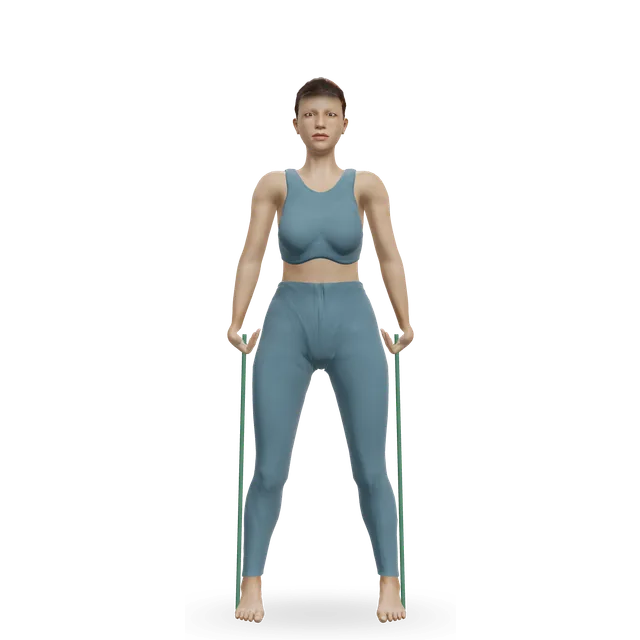
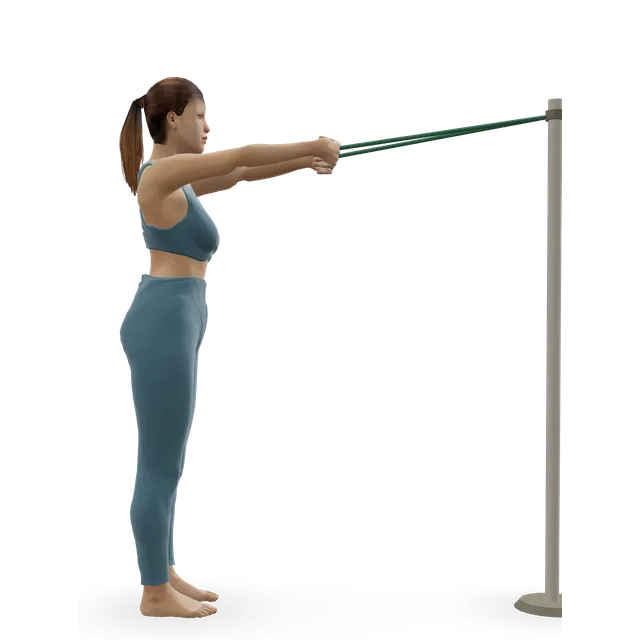
Standing band external rotation demonstrated on the 3D figure3D demoStanding band external rotationBeginner · A band + An anchor point

Without a band at first: elbows at your sides, forearms out and back, hold a few seconds; 2 to 3 at a time, every hour, building to about 10 · NHS inform's "wide shoulder stretch", with its pacing; a light band comes later (editorial)

Easier: Stick-assisted external rotation (lying) · Harder: Side-lying external rotation

Band row demonstrated on the 3D figure3D demoBand rowBeginner · A band + An anchor point

3 sets of 10 to 15, stopping 2 to 3 reps short of failure, with 60 to 90 s rest · The move page's dose, an editorial starting point

Harder: Supported single-arm dumbbell row

Move on when: Everyday jobs below shoulder height are comfortable, you can lift the arm to shoulder height with only a mild ache at the shoulder blade, and you're no worse the next morning (editorial).

Follow along: a timer, a cue and the next move, one step at a time.
Stage 2

Shoulder blade and rotator cuff strength, working up through the arc

About weeks 2 to 8, 3 to 5 days a week: strength for the muscles that turn and hold the shoulder blade and for the rotator cuff, taking the arm a little higher each week within the pain rule.

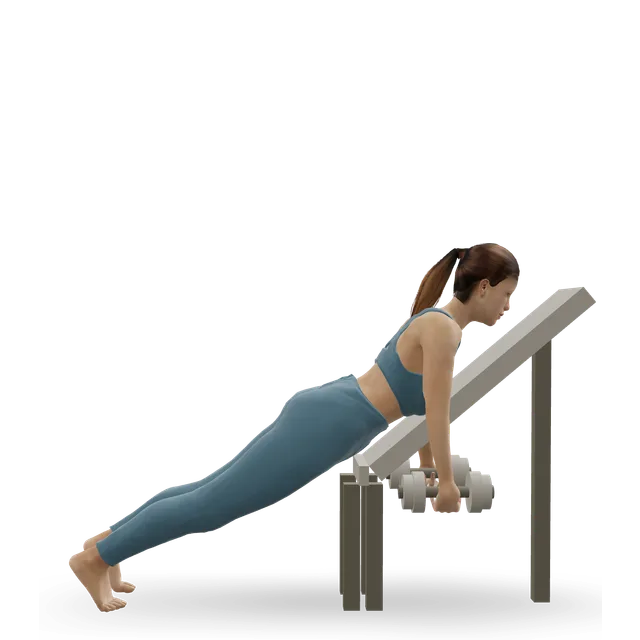
Scapular push-up (push-up plus) demonstrated on the 3D figure3D demoScapular push-up (push-up plus)Beginner · No equipment

2 to 3 sets of 10 to 15, against a wall, then a bench · Editorial, as in our shoulder pain when lifting your arm guide; serratus anterior strength is part of rehabilitation for a winging shoulder blade. Use an incline if your lower back sags, as the move page says

Easier: Dumbbell shoulder-blade punch · Harder: Push-up

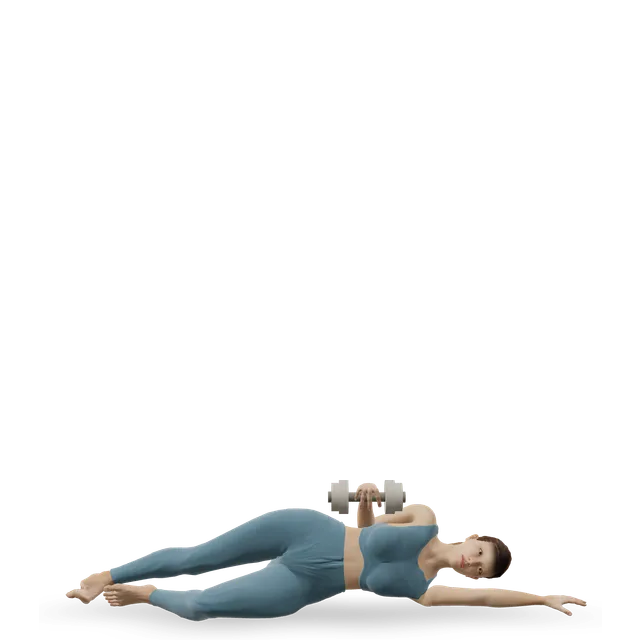
Side-lying external rotation demonstrated on the 3D figure3D demoSide-lying external rotationBeginner · A dumbbell

8 reps, a minute's rest, 8 more, 2 to 3 times a day, building to 2 sets of 15; then 3 sets of 15 once a day, lowering over about 3 s · NHS inform's "side rotation with weight" and its pacing, then the Holmgren trial's sets and reps (it used them twice a day for 8 weeks, then once a day)

Easier: Standing band external rotation · Harder: Cuban rotation

Scaption raise demonstrated on the 3D figure3D demoScaption raiseBeginner · A dumbbell

3 sets of 15, thumbs up, to shoulder height at first, lowering slowly; higher as the arc eases · The Holmgren trial's sets and reps, as in our shoulder impingement guide; the range is editorial

Easier: Band lateral raise · Harder: Smith machine upright row

Prone Y-T-W raises demonstrated on the 3D figure3D demoProne Y-T-W raisesBeginner · No equipment

2 sets of 6 to 8 of each shape · As in our upper back pain guide (editorial)

Easier: Wall angel · Harder: Bent-over reverse fly

Wall angel demonstrated on the 3D figure3D demoWall angelBeginner · A wall

2 sets of 8 to 10, within comfort · As in our upper back pain guide (editorial)

Easier: Table slide (seated forward reach) · Harder: Prone Y-T-W raises

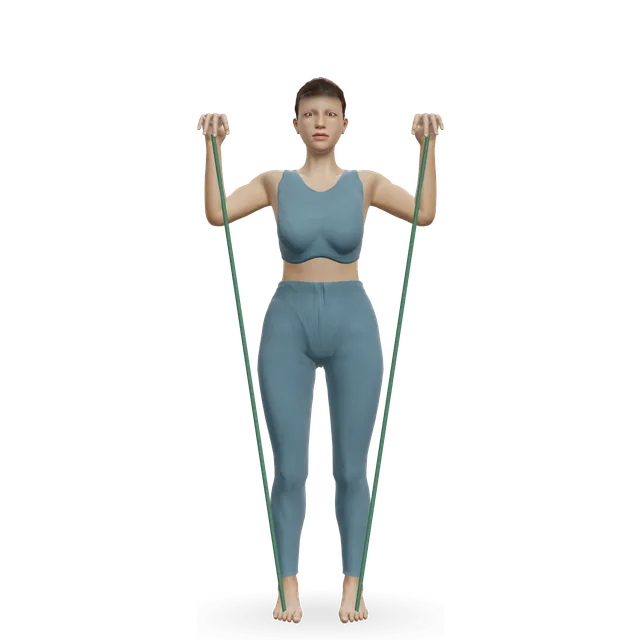
Band lateral raise demonstrated on the 3D figure3D demoBand lateral raiseBeginner · A band

2 minutes a day, 5 days a week, using a stronger band as it gets easy · The dose of a trial in which 2 minutes a day of progressive elastic-band training eased neck and shoulder pain in 198 workers. Its abstract doesn't name the exercise, so the band lateral raise is our choice (editorial), as in our tech neck and upper back from sitting guides

Harder: Dumbbell lateral raise

Move on when: Every set is within the pain rule, lifting the arm to shoulder height and a little above is comfortable, and the shoulder blade is no worse the next day (editorial).

Follow along: a timer, a cue and the next move, one step at a time.
Stage 3

Strength overhead, carrying, and reaching and lifting in full

From about week 6 to 8, 2 or 3 days a week, then twice a week: heavier rows and shrugs, pressing overhead and carrying, while reaching, overhead jobs and sport come back by the written steps below. How they come back is our suggestion: no trial has tested it.

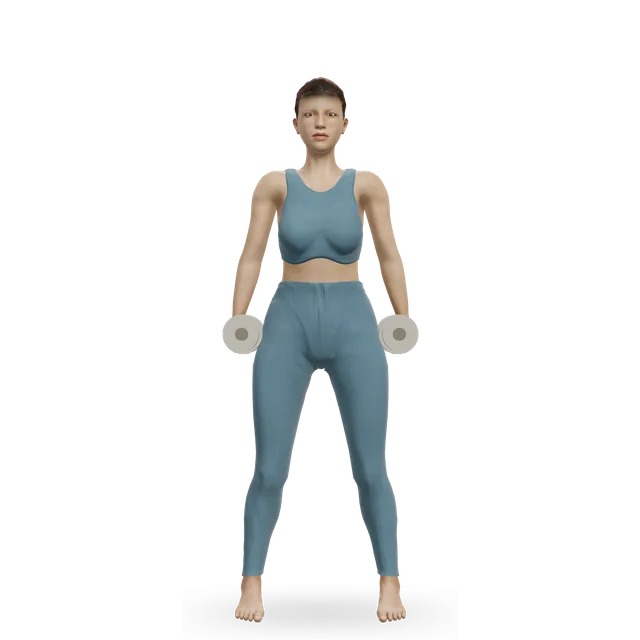
Dumbbell shrug demonstrated on the 3D figure3D demoDumbbell shrugBeginner · A dumbbell

2 to 3 sets of 8 to 12, stopping with 2 or 3 reps in reserve, pausing 1 s at the top · The move page's dose, an editorial starting point; shrugs were part of the strength training that eased trapezius pain

Harder: Snatch shrug

Chest-supported dumbbell row demonstrated on the 3D figure3D demoChest-supported dumbbell rowBeginner · A dumbbell + A bench or box

3 sets of 8 to 12 · As in our upper back pain guide (editorial)

Harder: Supported single-arm dumbbell row

Face pull demonstrated on the 3D figure3D demoFace pullIntermediate · A band

3 sets of 12 to 15 · As in our upper back pain guide (editorial)

Easier: Prone Y-T-W raises · Harder: Tuck back lever

Shoulder press with a band demonstrated on the 3D figure3D demoShoulder press with a bandBeginner · A band

3 sets of 8 to 12 · As in our shoulder pain when lifting your arm guide (editorial); press only as high as stays within the pain rule

Harder: Push press

Farmer's carry demonstrated on the 3D figure3D demoFarmer's carryIntermediate · A dumbbell + A kettlebell

3 walks of 20 to 30 m · As in our upper back pain guide (editorial)

Harder: Suitcase carry

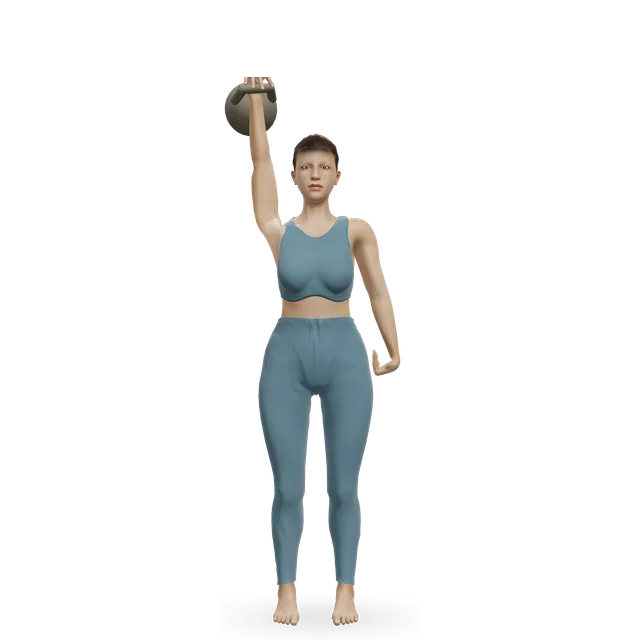
Overhead carry (waiter's walk) demonstrated on the 3D figure3D demoOverhead carry (waiter's walk)Intermediate · A dumbbell + A kettlebell

2 to 3 walks of 10 to 20 m with a light weight, last and optional · Editorial. Only once pressing overhead is comfortable: the move page says it isn't for painful or unstable shoulders

Easier: Suitcase carry · Harder: Yoke walk

Move on when: These pass the pain rule for 2 weeks, and overhead jobs, lifting and sport are back by the written steps. Then keep two strength sessions a week (our suggestion, as in our shoulder guides); if a busy week flares it, drop back a stage for a few days rather than stopping (editorial).

Follow along: a timer, a cue and the next move, one step at a time.

What to change for now

Reaching, lifting and carrying for now (written steps)

Our 3D figure can't show these. They come from the NHS, NHS inform and the HSE; none has been tested in a trial for this pain, and where a step is our suggestion, it says so.

  • 1. Keep using the arm for everyday jobs below shoulder height: the NHS says "do not completely stop using your shoulder", and NHS inform suggests moving it gently for 10 to 20 seconds every hour in the first 24 to 48 hours, then using it more.
  • 2. Reach high with a step stool rather than a long stretch, and move the things you use every day to lower shelves (our suggestion).
  • 3. Lift close to your body, and avoid lifting above shoulder height, especially heavy loads, for now (the HSE). For long lifts, rest the load halfway on a table or bench to change your grip (the HSE).
  • 4. Carry close to the body, split the load between both hands and swap sides (our suggestion; the HSE's carrying guideline assumes the load is held against the body).
  • 5. Hold off heavy gym presses, pull-ups and overhead sport until stage 3: NHS inform says avoid sports or heavy lifting until you have less discomfort and good movement.

Sources 45, 44, 62, 63

The desk, sleep and pain relief (written steps)

The desk steps are the HSE's and the sleep steps the NHS's, with our suggestions labelled. Sleep studies conflict, so go by comfort.

  • 1. Top of the screen level with your eyes, keyboard just below elbow height, mouse in line with your elbow, and sit high enough that you don't need to shrug your shoulders (the HSE).
  • 2. Break up screen work: "5 to 10 minutes every hour is better than 20 minutes every 2 hours" (the HSE), and move your neck for short periods every hour (NHS inform). Our upper back pain from sitting guide has the full set-up.
  • 3. Sleep with a pillow that keeps your head level with your body, on a firm mattress, and not on your front (the NHS, for neck pain).
  • 4. If lying on the sore side hurts, lie on the other side with a pillow to hug and rest the arm on (our suggestion).
  • 5. Heat or cold packs and paracetamol or ibuprofen can help neck pain, the NHS says.

Sources 66, 67, 39, 70, 7, 68, 69

Back to reaching, lifting and sport (written steps)

No trial has tested how overhead work comes back after this pain, so these steps are our suggestion unless a source is named.

  • 1. Overhead jobs come back one at a time: light and close to the body first, and heavy loads above shoulder height last (the HSE's guideline weights are lowest there).
  • 2. Long lifts rest halfway (the HSE).
  • 3. Overhead sport and gym presses come back once pressing with a band is comfortable, building load before speed.
  • 4. Keep two strength sessions a week.
  • 5. If a busy week flares it, drop back a stage for a few days rather than stopping.

Sources 62, 63

Positions to swap, and why

Habit or positionWhy it mattersInstead
Resting the arm completelyThe NHS says "do not completely stop using your shoulder".Everyday use below shoulder height and the supported table slide.Try: Table slide (seated forward reach)
Heavy or repeated lifting above shoulder heightThe HSE's guideline weights are lowest above shoulder height, and NHS inform says avoid heavy lifting until movement is good.A step stool and loads close to the body; rows instead of presses for now.Try: Band row
Heavy overhead pressing in the first weeksThe move page asks for comfortable overhead range without arching the lower back first, and loading the arm overhead can bring shoulder blade pain on (our reading).Wall angels and rows first, band presses later.Try: Wall angel
Carrying a weight overheadThe move page says it isn't for painful or unstable shoulders.Farmer's carries at your sides; overhead comes last.Try: Farmer's carry
Hauling your head down in neck stretchesThe move page says the hand is a guide, not a winch, and to stop for tingling into the arm.Gentle turns, tilts and nods.Try: Neck CARs (controlled articular rotations)
Digging into a "knot" with a roller or ball as the main treatmentExaminers can't reliably find trigger points, and strength training is what helped in trials.Brief rolling for comfort if you like it, then strength work.Try: Band row
Shrugging while you type or reachThe HSE says sit high enough that you don't need to shrug.Raise the chair or lower the desk; shoulder rolls between tasks.Try: Shoulder rolls
A heavy bag on one shoulderCarrying a backpack went with upper back pain in children and teenagers; for adults, this swap is our suggestion.Two straps, a lighter load, or swap sides.Try: Farmer's carry
Putting chest pain, breathlessness or sweating with arm effort down to a pulled muscleThese are the NHS's 999 and 111 signs for the heart.Stop and call 999, or NHS 111 for discomfort that settles with rest.
Pushing through tingling or numbness down the armThat is the neck rule's limit.A smaller range, or leave the move out for now.Try: Neck CARs (controlled articular rotations)

Routines to follow

More moves for this area

Questions people ask

Why does my upper back hurt when I lift my arm?

Lifting the arm turns the shoulder blade on your ribs and moves your neck and upper back (our reading of the anatomy), so a sore shoulder blade muscle, the rotator cuff, a stiff joint in the upper spine or a trapped nerve in the neck can all hurt as it rises. No study counts how often each is the cause; where it hurts and what comes with it point to which.

Why does my shoulder blade hurt when I raise my arm above my head?

Holding the arm up works the trapezius and the muscles that turn the blade hard, and lifting above shoulder level is when rotator cuff pain shows. A painful arc partway up points to the cuff; an ache along the inner edge of the blade that builds while the arm stays up points to the muscles.

Why can't I lift my arm because of upper back pain?

Usually pain stops the lift, and someone else can raise your arm further than you can. Sudden weakness after a fall or a jerk needs a same-day check, and severe pain followed days later by weakness or winging needs a GP soon. A weak or numb arm with a drooping face is a 999 call.

Could it be my neck?

Yes. In studies of trapped nerves in the neck, pain around the shoulder blade was common and sometimes came weeks before the arm pain. Pain, pins and needles or numbness down the arm point to the neck, and our pinched nerve in the neck guide has the plan.

Could it be my heart?

Rarely, but don't guess: call 999 for chest pain or pressure, or pain spreading to your arm, neck, jaw, shoulder or back with sweating, sickness or breathlessness. Discomfort that comes on with effort, such as carrying or reaching, and goes after a few minutes' rest can be angina: get help from NHS 111. In the US, call 911 where this page says 999.

Why does my left shoulder blade hurt when I lift my right arm?

As one arm lifts, the muscles on the other side brace your trunk, and a stiff upper back joint can be stirred by the turn (our reading). The same warning signs apply on either side.

Is it a knot?

It might be a sore muscle, but knots are hard to pin down: examiners don't reliably agree where they are. Rubbing can feel good, but strength training is what helped this kind of muscle pain in trials.

What exercises help?

Gentle upper back rotations and supported arm lifts first, then rotator cuff and shoulder blade strength, then rows, shrugs, presses and carries. Even 2 minutes a day of band exercise eased neck and shoulder pain in office workers.

Should I stop lifting things?

Not completely: the NHS says don't stop using your shoulder. Keep heavy and repeated lifting above shoulder height for later, lift close to your body, and rest long lifts halfway.

Why does my upper back hurt when I lift weights overhead?

Usually the shoulder blade muscles or the rotator cuff are working near their limit. Drop to lighter, lower and slower work within the pain rule, rows before presses, and build back over weeks. Pain with chest tightness or breathlessness during effort is a different matter: see the warning signs.

Do I need a scan?

Usually not: disc and joint changes are common in people without pain, and NHS inform says scans aren't usually needed. A scan matters for weakness that is getting worse, a suspected fracture with thin bones or symptoms that aren't settling.

How long will it take?

No one can promise a date. NHS inform expects neck problems to begin to settle within 8 weeks and shoulder problems within 6, but shoulder pain can take 6 months or longer, and a trapped nerve up to a year.

Related exercise guides

Other pain guides

Sources

  1. Briggs 2009 · Upper and mid back pain in the general population: 33 studies (systematic review, BMC Musculoskelet Disord)
  2. Carmichael 2025 · Shoulder blade pain in a trapped neck nerve (scoping review of 86 studies, N Am Spine Soc J)
  3. Fukui 1997 · Pain patterns from the small joints of the upper back in 15 people (clinical study, Reg Anesth)
  4. Andersen 2008 · Muscle activity in five strength exercises in women with chronic neck muscle pain (study of 12 women, Physical Therapy)
  5. Andersen 2008 · Specific strength training vs general fitness for chronic neck muscle pain (RCT of 48 women, Arthritis Rheum)
  6. Lucas 2009 · How reliably trigger points can be found by examination: 9 studies (systematic review, Clin J Pain)
  7. NHS inform · Subacromial pain syndrome
  8. Bayam 2011 · Pain maps for common shoulder problems in 94 people (prospective study, Am J Orthop)
  9. Michener 2009 · Accuracy of five examination tests for subacromial impingement in 55 patients (diagnostic study, Arch Phys Med Rehabil)
  10. Tanaka 2006 · Neck nerve roots as the source of neck and shoulder blade pain in 50 people (surgical series, Spine)
  11. Mizutamari 2010 · Where the shoulder blade hurts with each trapped neck nerve root in 25 people (clinical study, J Orthop Surg)
  12. Rubinstein 2007 · How accurate neck tests are for a trapped nerve: 6 studies (systematic review, Eur Spine J)
  13. Davidson 1981 · Pain relief with the hand on the head (the shoulder abduction test) in 22 people (clinical study, Spine)
  14. Radhakrishnan 1994 · Cervical radiculopathy in Rochester, Minnesota, 1976 to 1990: 561 people (population study, Brain)
  15. Dreyfuss 1994 · Where pain from the small joints of the mid back is felt: 9 healthy volunteers (experimental study, Spine)
  16. Young 2008 · Where pain from the rib joints beside the spine is felt: 8 healthy volunteers (experimental study, BMC Musculoskelet Disord)
  17. Martin 2008 · Scapular winging: anatomy, diagnosis and treatment (review, Curr Rev Musculoskelet Med)
  18. Sanchez-Urgelles 2025 · Serratus anterior palsy from the long thoracic nerve (review, JSES Rev Rep Tech)
  19. Friedenberg 2002 · Natural history of long thoracic and spinal accessory nerve injuries in 106 people (cohort, Muscle Nerve)
  20. van Alfen 2006 · Neuralgic amyotrophy in 246 people (case series, Brain)
  21. van Alfen 2015 · How common neuralgic amyotrophy is in Dutch primary care (prospective cohort, PLoS One)
  22. NHS · Angina
  23. NHS · Heart attack
  24. British Heart Foundation · Signs and symptoms of heart attacks in women
  25. Coventry 2011 · Sex differences in heart attack symptoms (systematic review and meta-analysis, Heart Lung)
  26. NHS · Pulmonary embolism
  27. NHS · Costochondritis
  28. Klompas 2002 · Does this patient have an acute thoracic aortic dissection? 21 studies (systematic review, JAMA)
  29. NHS inform · Gallstones
  30. NHS · Acute cholecystitis (past its review date: reviewed February 2023, review due February 2026)
  31. Panagopoulos 2014 · Pancoast tumours: features and assessment before surgery (review, J Thorac Dis)
  32. NHS · Symptoms of lung cancer
  33. NHS · Gallstones
  34. NHS · Cervical spondylosis (past its review date: reviewed August 2023, review due August 2026)
  35. NHS · Shingles
  36. NHS · Polymyalgia rheumatica (past its review date: reviewed April 2023, review due April 2026)
  37. NHS · Osteoporosis (past its review date: reviewed October 2022, review due October 2025)
  38. NHS · Dislocated shoulder
  39. NHS inform · Neck problems
  40. NHS inform · Cervical radiculopathy
  41. Nakashima 2015 · Neck MRI findings in 1,211 people without symptoms (cross-sectional study, Spine)
  42. Wood 1995 · Upper back MRI findings in 90 people without symptoms (cross-sectional study, J Bone Joint Surg Am)
  43. NHS inform · Mechanical neck pain
  44. NHS inform · Shoulder problems
  45. NHS · Shoulder pain (past its review date: reviewed May 2023, review due May 2026)
  46. Kuijpers 2004 · What predicts recovery from shoulder problems: 16 cohorts (systematic review, Pain)
  47. Hush 2011 · The course of new neck pain: 7 cohorts (systematic review and meta-analysis, Arch Phys Med Rehabil)
  48. Holmgren 2012 · Specific exercise and the need for surgery in subacromial impingement in 102 people (RCT, BMJ)
  49. Hopewell 2021 · Progressive exercise vs best practice advice, with or without steroid injection, for rotator cuff disorders: GRASP (RCT, Lancet)
  50. Littlewood 2016 · A single self-managed exercise against usual physiotherapy for rotator cuff tendinopathy: the SELF trial (randomised trial, Clin Rehabil)
  51. Andersen 2011 · 2 or 12 minutes a day of band training for neck and shoulder pain in 198 workers (RCT, Pain)
  52. Gross 2015 · Exercises for mechanical neck disorders: 27 trials (Cochrane review)
  53. Peek 2015 · Upper back manual therapy for shoulder pain (systematic review, J Man Manip Ther)
  54. Bizzarri 2018 · Upper back manual therapy against placebo for shoulder problems: 4 trials (systematic review and meta-analysis, Musculoskelet Sci Pract)
  55. Yu 2026 · Types of upper back manual therapy for shoulder problems: 12 studies of 508 people (systematic review and meta-analysis, Musculoskelet Sci Pract)
  56. Masaracchio 2019 · Manipulation of the upper back for neck pain: 14 trials (systematic review and meta-analysis, PLoS One)
  57. Plummer 2017 · Uneven shoulder-blade movement in 135 people with and without shoulder pain (diagnostic study, JOSPT)
  58. Hickey 2018 · Uneven shoulder-blade movement and later shoulder pain in 419 athletes: 5 studies (systematic review and meta-analysis, Br J Sports Med)
  59. Kibler 2013 · Clinical implications of uneven shoulder-blade movement (consensus statement, Br J Sports Med)
  60. Bury 2016 · Shoulder-blade-focused treatment for rotator cuff shoulder pain (systematic review and meta-analysis, Man Ther)
  61. Saito 2018 · Shoulder-blade-focused interventions for subacromial pain: 6 trials (systematic review and meta-analysis, Physiother Theory Pract)
  62. Health and Safety Executive · Manual handling at work: a brief guide (INDG143, 2020)
  63. Health and Safety Executive · Manual handling at work: good handling technique
  64. van Rijn 2010 · Work-related factors and specific shoulder disorders (systematic review, Scand J Work Environ Health)
  65. Versloot 2024 · Physical and psychosocial work exposures and shoulder disorders (systematic review update, Appl Ergon)
  66. Health and Safety Executive · Good posture when using display screen equipment
  67. Health and Safety Executive · Work routine and breaks (display screen equipment)
  68. Kempf 2012 · Side of shoulder pain and preferred sleeping side in 83 patients (cross-sectional study, J Manipulative Physiol Ther)
  69. Holdaway 2018 · Sleep position, shoulder pain and rotator cuff tendinopathy in 761 workers (cross-sectional study, BMC Musculoskelet Disord)
  70. NHS · Neck pain (past its review date: reviewed April 2023, review due April 2026)
  71. NHS inform · Exercises for shoulder problems
  72. NHS inform · Exercises for neck problems
  73. Wrightington, Wigan and Leigh Teaching Hospitals NHS Foundation Trust · Neck and upper back exercises, level 2 (physiotherapy leaflet, 2024)
  74. Smith 2017 · Should exercises be painful in chronic musculoskeletal pain? 7 trials (systematic review and meta-analysis, Br J Sports Med)

Exercise education, not a diagnosis or treatment plan. It is written from the guidelines and studies listed above; review by a clinician is pending. If your pain follows an injury, is severe, is getting worse, or comes with any warning sign listed on this page, get it assessed. Health disclaimer.